


Lecture of H.E. Najib Mikati at Oxford Center For Islamic Studies “Islam
Thursday, Feb 19, 2015
Honorable Farhan Nizami,
Dear Professors and Students of Oxford Centre of Islamic Studies,
Distinguished Guests,
I am honored to be present today at one of the pinnacles of world knowledge known to men, and a beacon of Western education that spans across disciplines and schools of thought. I am humbled by the invitation to present a lecture in the confines of these walls on a subject that is close to my heart, dear to many and at the core of a world debate.
The debate that rages today is about Islam and how it might be on a collision course against other religions especially within the modern Western society. For me, this is a fundamentally false debate. Religious/theological beliefs clash with no societal organization since they connect to all people at the spiritual level. What seems to be coming to the fore are rather cultural differences between people, amplified by the weight of economic pressures, fast communication means and political turmoil. I dare to suggest that religion is firmly outside this debate.
When watching the evening news or grabbing the morning papers, one has the clear sense that something is confusing in the relationship between Islam and the Western world. This is translated by growing signs of fear and mistrust. Fear has primarily to do with the issue of violence: violence that transcends the ancient past and the modern present, from suicide attacks, the conquest of Spain, the Crusades, colonialism, the Iraqi war, Palestine, headscarves, youths rioting in the suburbs, jihad, provactive humor, and the freedom of speech...Quite a mess!!!
I am neither a theologian nor a historian but a man whose faith fills his life. I view Islam, my religion, and that of 1.2 billion around the world, to have relayed important messages that have gone unnoticed beyond a certain circle of curious researchers or brave intellectuals. Those messages are filled with humanity, humility and equality, and one can draw many lessons and construct the linear trajectory of what Islam wanted to instill in societies at the onset.
I will start with the Message on women, and entrepreneurship.
Islam is always portrayed in the Western media, as discriminating against women and especially one that confines the role of women to procreation and household duties.
Khadija, the first wife of the Prophet (PBUH), was a lady-entrepreneur, not an idle homemaker. Khadija was a very successful trader. Her business outnumbered all other traders if the Meccan tribes put together. Moreover, Khadija employed others to trade on her behalf for a fee. She hired Prophet Muhammad (PBUH) as her sales representative.
Ladies & Gentleman,
14 hundred years ago a rich female merchant was prophet Muhamad’s first and only employer. This event established a guidance for the role of women in business as productive, full economic partners in Muslim culture since the first teachings of Islam.
I will move to the Message on Racial Equality.
Bilal ibn Rabah was one of the most trusted and loyal companion of the Prophet. Born as a slave, Bilal was among the emancipated slaves freed by Abu Bakr due to the Islamic teachings on slavery. In the Arabian Peninsula at the time, racism, under the name of tribalism, was prevalent in Makkah. The Meccan tribesmen in particular, and Arabs in general, considered themselves superior to all the other peoples of the world. A black man had no place amongst the Arabian tribes except as a slave, and that, way before Islam. The Quran stated that no Arab is superior over a non-Arab, and no white is superior over black and superiority is by righteousness and God-fearing alone (Surat Al-Hujurat, 49:13). Prophet Muhamad (PBUH) also declared that if a Black Muslim were to rule over Muslims, he should be obeyed. Such an early and most controversial act of racial equality, by promoting Bilal into a prominent position within a nascent religion was a powerful message that reverberated long and far.
What about the Message on harmony?
Prophet Muhammad (PBUH) came to Medina after a period of thirteen years of preaching Islam in Makkah. At that time, the city of Medina and its surrounding area were home to many Jewish, Christian and other Arabian pagan tribes. There were also people of various racial and national origins including Romans, Persians and Ethiopians.
Taking into consideration the hopes and aspirations of this community of multi-ethnic, multi-religious background, Prophet Muhammad (PBUH) drew up the basic principles of a pluralistic constitution. The new constitution helped strengthening the unity between the emigrants from Makkah and the people of Medina. Moreover, it established the rights and equality of every citizen, irrespective of their religious orientation, before the law, as well as freedom of belief, trade, and speech. The following is a statement by the Prophet on this subject: "Let it be known, if any one (Muslim) commits injustice, insults, aggravates, mistreats, or abuses a person of the People of the Book (who are protected, by the state or an agreement), he will have to answer me (for his immoral action) on the Day of Judgment." (Izzeddin Blaque, Minhaj Alsaliheen, 106)
Distinguished guests,
Let’s move to Current issues and topics of social relevance such as fashion and humor.
Let me start with Fashion.
Is clothing a religious matter? I think it is rather a sign of cultural difference. The Kimono in Japan, the Sari in India, the Quilt in Scotland, and the trousers in many corners of the world, reflect climate and cultural factors. So is the head-cover from a cowboy hat, to the Russian Ushanka, and the Arabian headscarf. Still, most people think of the veil solely in religious terms affiliated with Islam, and tend to forget that it is much older. It originated from ancient Indo-European cultures, such as the Greeks, Romans and Persians. It was also common with the Assyrians. Veiling had class, as well as gender implications. The strong association of veiling with class rank, as well as an urban/peasant split, persisted historically up until the last century. Women in medieval Europe dressed more like women in the Muslim world than is generally realized. It was customary, especially for married women, to cover their hair with various kinds of headdresses. It was common to drape the neck and even sometimes the lower face in a wimple. This became part of the classic nun's outfit that represents the most conservative style of female dress in the Christian world.
As we know, Western societies have moved on from this former fashion trend. Yet the veil causes such a controversy, initiates bans, enacts laws and fosters discrimination in the streets!! This is an example of modern society rejecting an old habit and accusing those who maintain it of religious backwardness, not simply looking at it as being out of fashion.
What about Humor?
Weeping is universal, but laughing is not. What is funny for an English audience could seem boring for a North American crowd; and what is satirical in France could look blasphemous in Africa. It is a question of sensibilities, of course, I am not suggesting censorship, absolutely not! But it does trigger the question of whether humor could be misplaced? Not illegal and not in any way restricted, but inappropriate, rude or edgy?
Humor incompatibility is as much a fact, as is humor compatibility. Some people get it and some don’t. What gives one the right of expressing it, gives the other the right to be displeased by it. The difference in humor is cultural, it varies from country to country and from region to region.
Again, what is funny in New York may not in Texas, and what is funny in Marseilles might be less so in Paris. In the United States religiously inspired humor does not go beyond the confines of stand-up comedy clubs and seldom into the broader media. Why? Because the US is a deeply religious society with references to God on many symbols of the republic: from the Constitution to the Dollar Bill.
Consider for a moment, an American dollar bill emblazoned, across it the phrase “In God We Trust”. This does not worry the western society! Yet, if a Muslim utters the phrase “In Allah We Trust”, one tends to be treated with suspicion that somehow the belief in Allah might carry with it the possibility of a fanatic gun-waving terrorist..!!
Ladies and Gentlemen,
Another cliché of religious divide, is that Muslims live principally in non-democratic regimes therefore Islam rejects democracy, and some pundits assert that Islam as a religion does not encourage freedom of speech. But when communism prevailed in the USSR, and Nazism in Germany, Fascism in Spain and Italy, was Christianity blamed for promoting totalitarian regimes? Such regimes have no religion, creed or nationality.
The transition from totalitarianism to liberal democracy is always painful. Certainly it was painful in Europe as it is in both Arab and Muslim countries, but unsurprisingly labeling certain Muslim societies as non-democratic purely on religious grounds– rather than for political reasons- is a grave show of lack of knowledge and a great display of racism.
Ladies and Gentlemen,
Faced with a rapid, and ever-changing modern society, people from all creeds, religions and backgrounds are hardly coping with the shifting social landscape. Religions, all confounded, are being surpassed by modernity. Such fast changes are ripping apart old beliefs, social tenets, civic rules, and communal frameworks. Discomfort brings about fears of the unknown, biases from the unfamiliar, and doubts about the ‘other’, the ‘alien’, the ‘different’.
As I mentioned earlier, the challenge of Islam with modernization is neither religious nor theological. Islam and modernization are not mutually exclusive. Islam was one of the first religions that promoted modernization 14 centuries ago in Arabia. The challenge is fact cultural or I would say, multi-cultural.
What is common between Islam and many religions, in terms of dogmas, principles, and spiritual beliefs, are far greater than what is apart. However, cultural patterns between nations combined with a fast moving modern society are pitting more non-religious issues into the fold, than any differences of interpretations in Godly scriptures.
Understanding the narrative dimensions of the conflict is greatly needed because recent events have significantly increased temptations to embrace deeply polarized positions. At the popular level, narratives of inter-cultural rivalry have already become dominant.
To avoid becoming trapped into this never ending destructive debate, we must come together as experts in politics, education, sociology and communication to launch a consortium where policies based on inclusivity and tolerance can be discussed and initiated. Dialogue should be established on all different levels, otherwise extremists from all sides will set the pace trying to prevail.
Distinguished guests,
I will end by saying that “Morality consists in avoiding excesses by giving limits to our own freedom; and tolerance, is to let others set their own limits, as part of a living-together in respect.“
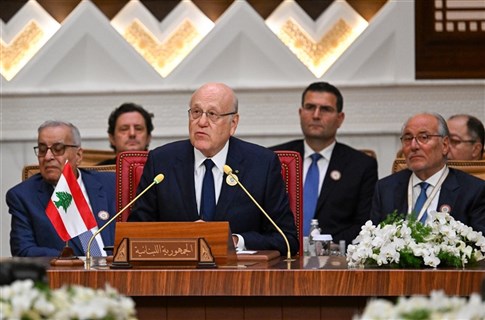
A living example of a multi-cultural democratic society is Lebanon, where people coming from over 20 religious and ethnic backgrounds have been living together, for centuries, in total serenity and mutual respect.
It’s about time for moderates, or “the silent majority”, to take the lead and become more proactive. Extremists never portray the true values of any religion they belong to. No matter how religiously different we might be, tolerance and mutual respect are the only way to bring us together, culturally.


